
Équipement d'enroulement automatique à cage en acier: l'équipement d'automatisation de base pour le traitement des barres d'acier pour fondations sur pieux
L'équipement d'enroulement automatique pour cages en acier (Machine à souder/bobineuse à cage en acier CNC, principalement) est un équipement d'automatisation spécialisé pour le traitement des cages en acier dans les pieux coulés sur place dans les ponts, train à grande vitesse, projets de construction et autres projets d'ingénierie. Il peut réaliser l'intégration du positionnement du renfort principal, enroulement en spirale d'un renfort de cerceau, et opérations automatiques de soudage/reliage, remplaçant complètement la reliure manuelle traditionnelle, améliorant considérablement l'efficacité de la production, précision du traitement et qualité de l'ingénierie. C'est l'équipement standard de base des usines modernes de transformation de l'acier..
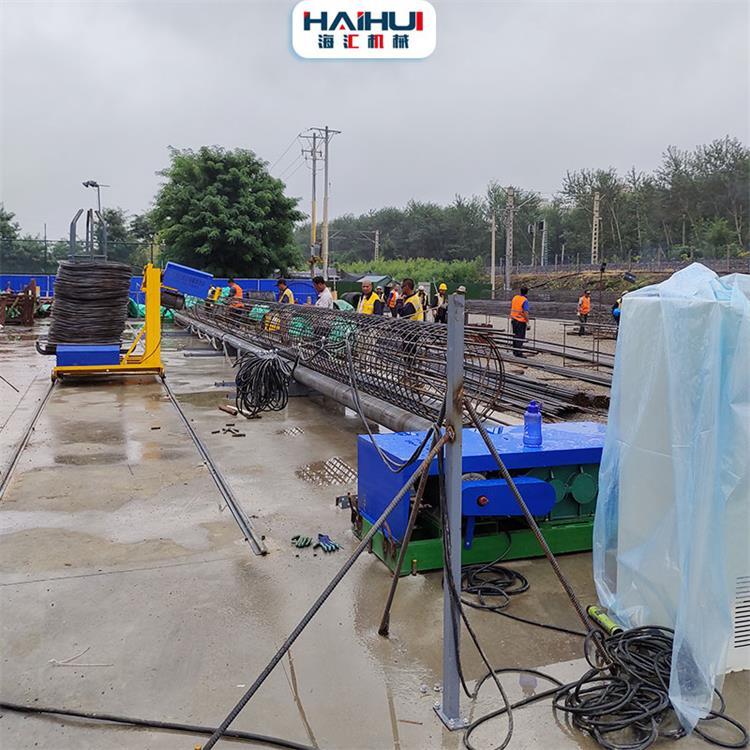
Définition de base et principe de fonctionnement
Ce type d'équipement est basé sur un contrôle de conversion PLC+servo/fréquence, et achève le remontage grâce à l'action coordonnée de “rotation+avance linéaire”:
Positionnement du renfort principal: Aider manuellement à insérer le renfort principal dans le disque rotatif fixe et les trous du gabarit de disque rotatif mobile et à les fixer, former un squelette de cage.
Entraînement d'enroulement: Le rouleau en caoutchouc/rouleau de friction entraîne la rotation du squelette, et la petite voiture portant les nervures sinueuses se déplace à vitesse constante le long de la piste, terminer l'enroulement en spirale à une distance définie.
Soudure de formage: soudage synchrone pendant le bobinage (comme le soudage de protection CO ₂) ou soudage/reliure uniforme après enroulement rapide, formant finalement une cage en acier circulaire de haute précision.
Contrôle de base: L'écran tactile définit des paramètres tels que le diamètre, longueur, et espacement entre les étriers, qui sont automatiquement stockés et exécutés par le système. Il prend en charge la télécommande (≤ 50 m).
Composition de la structure de l'équipement (conception modulaire, facile à démonter et à transporter)
Description des fonctions des composants de base du module
Le cadre principal est soudé avec une base, rouleaux électriques, et un système de transmission pour soutenir la cage et fournir une puissance de rotation, adapté à différents diamètres et poids
Le chariot d'enroulement de fil est équipé d'une bobine de fil, lisseur, et mécanisme de marche pour stocker les bobines de fil, fils de redressage et d’alimentation. Il avance à vitesse constante selon le programme, et l'espacement est réglable en continu
Système de contrôle électronique PLC, écran tactile, convertisseur de fréquence, programmation des paramètres du servomoteur, surveillance en temps réel, contrôle précis de la vitesse et de l'avance
Support d'alimentation automatique à mécanisme auxiliaire, dispositif d'anneau de support, bras de robot de soudage renfort principal alimentation automatique, support anti-déformation, soudage automatique (facultatif)
Le dispositif de déchargement peut ouvrir et fermer le support de matériaux, et le mécanisme d'éjection hydraulique peut décharger rapidement les produits finis, convient aux cages longues (≤ 24 m) transport
Paramètres techniques clés (référence pour les modèles grand public, tel que SGH22-12, série RKGH)
Plage typique d'éléments de paramètres, Indice de précision, Remarques
Convient pour un diamètre de cage de Φ 600- Φ 2500 mm, avec une erreur de diamètre de ≤ ± 5 mm, réglable en taille réelle, convient aux fondations sur pieux, piliers du pont, etc
Longueur de traitement 3-24 m (personnalisable plus longtemps) avec une erreur de longueur de ≤ ± 10 mm pour la production de joints simples ou multiples
Spécifications des renforts: F 5- Φ 14 mm, erreur d'espacement: ≤ ± 3 mm, espacement: 0-300mm, réglable en continu
Spécification principale du renforcement: F 12- Φ 40 mm. Déviation de concentricité: ≤ ± 2 mm. Le nombre de renforts principaux peut être ajusté selon les besoins
Efficacité de production de 12 m/section/20-30 sections/jour (6-8 personnes) est 3-5 fois plus élevé que le travail manuel, remplacer la charge de travail manuelle de 10-15 personnes
La puissance totale est d'environ 15 à 25 kW., et la consommation d'énergie est réduite d'environ 40% par rapport aux processus traditionnels. Le servomoteur est plus économe en énergie et plus précis
Avantages essentiels (par rapport à l'artisanat traditionnel)
Efficacité doublée: Les opérations automatisées réduisent considérablement le travail manuel, augmenter considérablement la capacité de production en une seule équipe, et raccourcir les délais des projets.
Précision contrôlable: L'espacement entre les étriers est uniforme (avec une erreur de ≤ ± 3 mm), la concentricité de la cage est élevée, et le diamètre est conforme, qui répond aux exigences de la norme nationale et évite les risques de qualité causés par des erreurs manuelles.
Optimisation des coûts: Réduire les coûts de main d’œuvre (opération par une seule personne), perte de matière moindre (≤ 2%), coûts d'entretien réduits, et un retour sur investissement élevé à long terme.
Qualité stable: Emballage serré, déformation minimale, soudure ferme, améliorer la capacité portante des fondations sur pieux et la sécurité structurelle.
Convivial: conception modulaire, transition pratique; Stockage des paramètres, changement rapide, et une dépendance réduite à l’égard des compétences des travailleurs.
Scénarios applicables et applications typiques
Infrastructures de transport: Traitement en série de cages en acier pour ponts ferroviaires/autoroutiers à grande vitesse, traverser les ponts maritimes, et fondations sur pieux tunnel.
Construction de bâtiments: Construction de pieux coulés sur place pour immeubles de grande hauteur, sous-sols, galeries de tuyaux, etc.
Ingénierie de la conservation de l'eau: production de cages en acier pour fondations profondes telles que barrages, ports, et quais.
Composants préfabriqués: production de cages en acier standardisées pour les usines de PC et les usines de pieux tubulaires.
Cas: Un projet de pont à grande vitesse a utilisé une machine à souder à rouleaux SGH22-12, avec une équipe de 6 personnes traitant 22 sections de cages de 12 m de long par jour, économie 60% de travail par rapport au travail manuel. L'erreur d'espacement des étriers a été contrôlée à ± 2 mm près, et le taux de réussite de la première acceptation était 100%.
Points clés d'exploitation et de maintenance
Normes d'exploitation:
Courir sans charge pendant 15 minutes avant de démarrer, vérifie les rouleaux, câblage, et système de soudage.
Processus d'essai 1-2 pièces, confirmer la taille et l'espacement, puis produire en masse.
Le traitement des cages longues nécessite un support auxiliaire pour éviter l'affaissement et la déformation au milieu.
Entretien et maintenance:
Nettoyer quotidiennement la limaille de fer, vérifier la lubrification des rouleaux et des chemins de roulement.
Vérifier les fixations et les joints de soudure chaque semaine, et remplacer la graisse de la boîte de vitesses une fois par mois.
Le système électrique doit être étanche à l'humidité et à la poussière.. S'il n'est pas utilisé pendant une longue période, le courant doit être coupé et couvert pour se protéger.
Tendances de sélection et de développement
Proposition de sélection: Sélectionnez le type de machine en fonction du diamètre de la cage, longueur, et le résultat du projet, et privilégier les équipements modulaires et évolutifs avec fonction de soudage automatique, adapté à une réutilisation multi-scénarios.
Tendances technologiques:
Mise à niveau intelligente: Introduction de l'inspection visuelle pour surveiller la qualité du soudage et les écarts dimensionnels en temps réel.
Intégration intégrée: lié au sciage, filetage, et des lignes de polissage pour réaliser un traitement de l'acier sans personnel tout au long du processus.
Économie d'énergie verte: le système d'asservissement optimise la consommation d'énergie, la purification des fumées de soudage améliore le niveau de protection de l'environnement.
Cet équipement favorise le traitement des barres d'acier de “manuel brut” à “CNC bien” grâce à l'automatisation et au contrôle précis, offrant une double garantie de qualité et d’efficacité de l’ingénierie. Pour les entreprises de construction, investir dans un équipement de remontage automatique adaptatif à cage en acier est une mesure clé pour réduire les coûts, augmenter l'efficacité, et améliorer la compétitivité de base.